Determination of Tryptophan-Derived Metabolites in Dried Blood Spots by UPLC–FLD/UV
Introduction
Vitas AS has developed and validated an analytical method for the quantitative determination of selected tryptophan-derived metabolites in dried blood spot (DBS) samples.
The method is based on Ultra-high-performance liquid chromatography (UPLC) with ultraviolet (UV) and fluorescence (FLD) detection and provides simultaneous quantification of multiple analytes from a single DBS sample.
The assay is optimized for high-throughput laboratory analysis using standardized sample preparation and chromatographic conditions.
Analytical Principle
The analytical procedure (Method AM-654) utilizes reversed-phase high-performance liquid chromatography coupled with dual UV and fluorescence detection.
The method quantitatively determines selected tryptophan-derived metabolites including:
Tryptophan (TRY)
Kynurenine (KYN)
Indole-3-propionic acid (IPA)
Additional analytes may be included depending on the analytical configuration.
Chromatographic conditions have been optimized to provide:
Efficient analyte separation
Stable retention times
High analytical specificity
Robust quantitative performance
Short analytical cycle time
Sample Matrix
The analytical matrix consists of dried capillary whole blood collected on standardized dried blood spot (DBS) cards.
The method has been developed and validated specifically for DBS samples.
Sample Preparation
Samples are prepared using an automated DBS punching system.
Individual discs are transferred to extraction vessels where analytes are extracted using a controlled aqueous-organic extraction procedure.
Following extraction, samples are centrifuged to remove particulate material before transfer to autosampler vials for chromatographic analysis.
The analytical workflow has been optimized for reproducible high-throughput laboratory operation.
Instrumentation
Analyses are performed using an UPLC system equipped with:
Binary solvent delivery system
Thermostatted autosampler
UV detector
Fluorescence detector
Detection parameters are optimized for each target analyte to maximize analytical sensitivity and selectivity.
Calibration
Quantification is performed using external calibration.
Each analytical sequence includes:
Multi-point calibration standards
Internal standards
Quality control materials
Calibration acceptance criteria are verified before sample results are accepted.
Quality Control
Each analytical batch includes predefined quality control procedures.
System suitability criteria include:
Standard recovery: 90–110%
Peak area precision (RSD): <5%
Carry-over: ≤2%
Blank response: <20% of the lowest calibration standard
Quality control samples are analyzed throughout each analytical sequence to verify system stability and method performance.
Method Performance
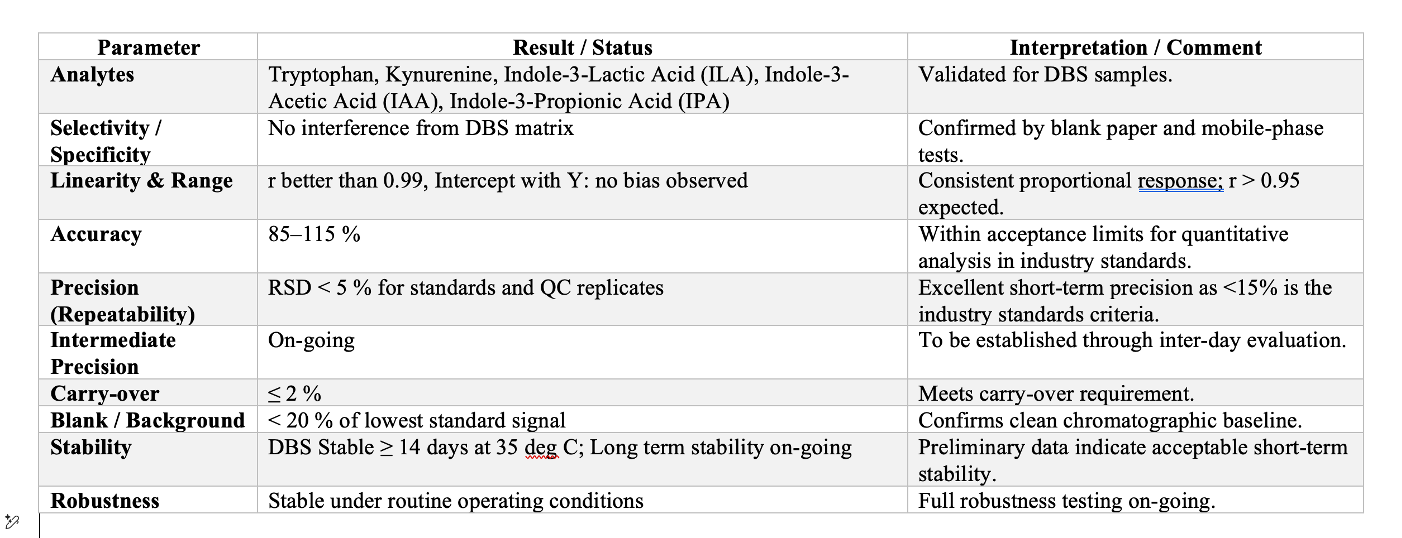
Method validation demonstrates:
Linear analytical response across the validated concentration range
High analytical precision
Good repeatability
Stable analyte recovery
Consistent chromatographic resolution
Minimal carry-over
No significant matrix interference from DBS filter paper
Routine analytical precision is maintained below 5% relative standard deviation (RSD) under validated operating conditions.
Laboratory Implementation
The analytical method is fully implemented within the Vitas quality management system.
All analytical activities are performed according to controlled laboratory procedures including:
Instrument qualification
Method validation
Calibration
Internal quality control
Analytical traceability
Data review and approval
Validation Summary
Method AM-654 (Revision 02) has been validated for quantitative determination of selected tryptophan-derived metabolites in dried blood spot samples.
Validation was performed in accordance with the principles described in ICH Q2(R2) and includes evaluation of:
Specificity
Linearity
Accuracy
Precision
Repeatability
Carry-over
Recovery
Analytical robustness
The method is suitable for routine quantitative laboratory analysis of dried blood spot samples.